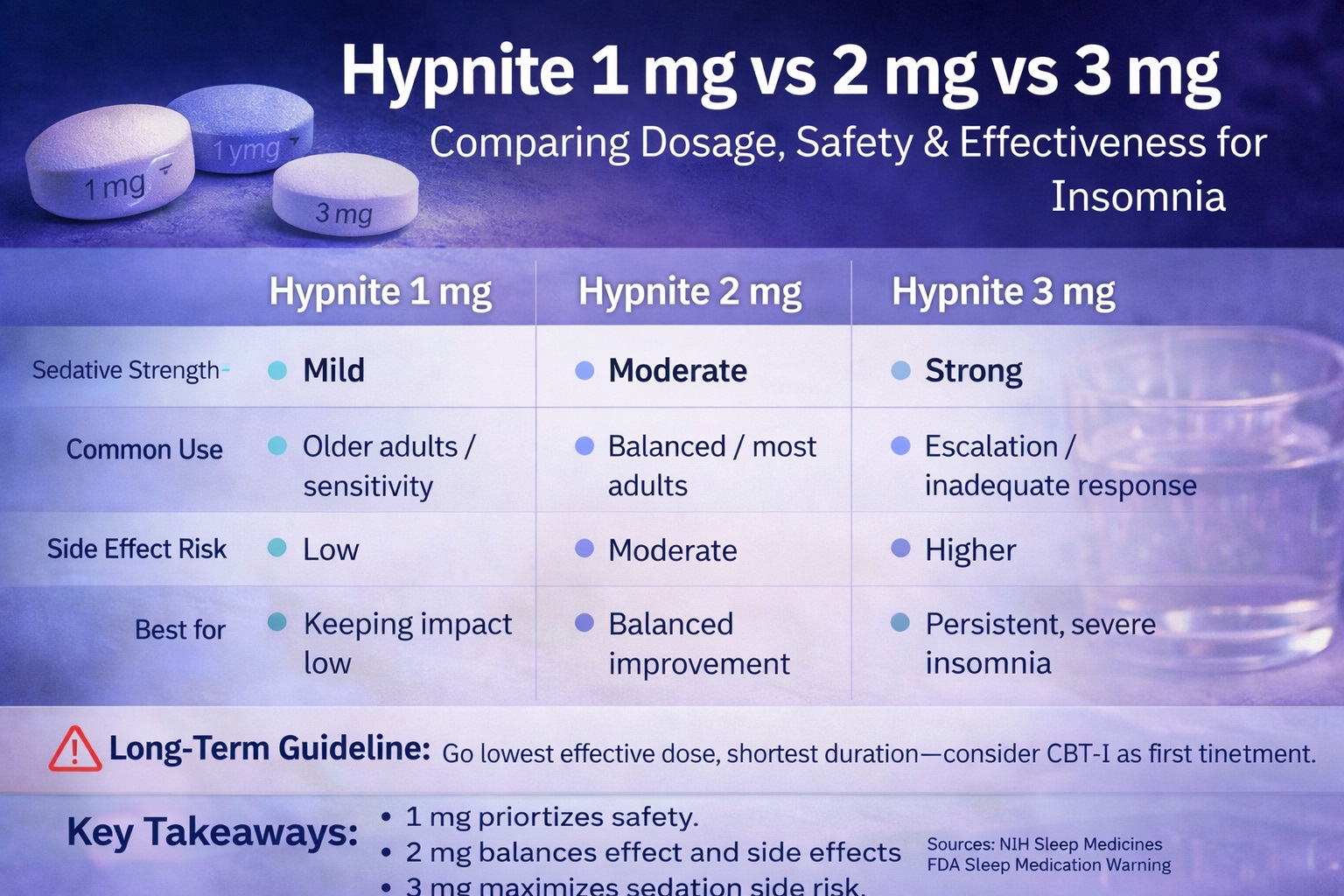
When it comes to sleep medications, dose selection matters as much as the drug itself. Hypnite is available in multiple strengths — 1 mg, 2 mg, and 3 mg — and each serves a distinct clinical purpose. Yet many patients understandably ask: Why not just take the strongest dose if insomnia is severe? In real-world practice, the answer is nuanced. This article compares Hypnite 1 mg vs 2 mg vs 3 mg, focusing on effectiveness, safety, and how clinicians typically approach dose decisions.
What Is Hypnite Used For?
Hypnite is prescribed for the short-term treatment of insomnia, particularly difficulties with sleep initiation and, at higher doses, sleep maintenance. It belongs to the class of non-benzodiazepine hypnotics (often called Z-drugs), which act on GABA-A receptors to promote sedation.
Regulatory authorities consistently emphasize lowest effective dose, shortest possible duration, due to risks such as tolerance, dependence, and next-day impairment.
According to the U.S. National Library of Medicine, hypnotic sleep medicines can improve sleep latency but before you buy hypnite it must be carefully dosed to reduce adverse effects .
Hypnite 1 mg vs 2 mg vs 3 mg Dose Comparison at a Glance
| Feature | Hypnite 1 mg | Hypnite 2 mg | Hypnite 3 mg |
|---|---|---|---|
| Sedative strength | Mild | Moderate | Strong |
| Typical role | Initial / cautious dosing | Standard adult dose | Escalation dose |
| Next-day drowsiness risk | Low | Moderate | Higher |
| Common patient profile | Older adults, sensitive patients | Average adult | Prior tolerance confirmed |
| Sleep maintenance benefit | Limited | Moderate | More pronounced |
Hypnite 1 mg: The Safety-First Option
When is 1 mg used?
Hypnite 1 mg is often selected when safety is the primary concern. In clinical settings, it is frequently prescribed for:
- Adults over 60
- Patients with low body weight
- Those taking other CNS-active medications
- Individuals with a history of medication sensitivity
While its hypnotic effect is milder, many patients with situational or mild insomnia report meaningful improvement without residual grogginess.
Clinical insight
In practice, we often observe that patients who believe “1 mg won’t do anything” are surprised when improved sleep onset occurs with minimal side effects.
Hypnite 2 mg: The Balanced Standard
Hypnite 2 mg is commonly considered the standard adult dose. It offers a balance between effectiveness and tolerability.
Benefits
- More reliable sleep onset than 1 mg
- Better nighttime continuity
- Acceptable side-effect profile for most adults
Limitations
Some patients experience:
- Mild morning drowsiness
- Reduced alertness if sleep time is shortened
- Diminishing effect with continuous nightly use
For many patients, 2 mg represents the optimal trade-off between sleep improvement and daytime functioning.
Hypnite 3 mg: Maximum Effect, Higher Risk
Hypnite 3 mg is generally reserved for patients who do not respond adequately to lower doses and who have previously tolerated hypnotics.
When might 3 mg be considered?
- Persistent insomnia despite lower doses
- Significant sleep maintenance problems
- Adequate time available for a full night’s sleep (7–8 hours)
Important caution
Side effects become more likely as dose increases. The U.S. Food and Drug Administration has issued warnings for non-benzodiazepine hypnotics regarding complex sleep behaviors — such as sleepwalking or performing activities while not fully awake — which may occur at therapeutic doses and are more concerning with higher exposure .
In real-world use, clinicians frequently step back from 3 mg if patients report morning impairment, even if nighttime sleep improves.
Why Starting Low Matters
A common misconception is that higher doses guarantee better sleep. In reality:
- Sedation increases faster than sleep quality
- Side effects rise disproportionately with dose
- Tolerance develops more quickly at higher strengths
This is why many prescribers follow a step-up approach:
1 mg → reassess → 2 mg → reassess → 3 mg (only if justified)
Long-Term Use and Alternatives
None of the Hypnite doses are intended for long-term nightly use. Prolonged exposure increases the risk of:
- Dependence
- Rebound insomnia
- Reduced effectiveness
Clinical guidelines increasingly favor cognitive behavioral therapy for insomnia (CBT-I) as first-line treatment, with hypnotics used as short-term support rather than a permanent solution.
Key Takeaways
- 1 mg prioritizes safety and is ideal for sensitive or older patients
- 2 mg offers the best balance for most adults
- 3 mg delivers stronger sedation but carries higher risk
- The goal is restorative sleep without daytime impairment, not maximum sedation
Choosing the right Hypnite dose is not about strength — it’s about fit.
References
- National Library of Medicine (NIH). Sleep Medicines: MedlinePlus.
https://medlineplus.gov/sleepmedicines.html - U.S. Food and Drug Administration. FDA adds Boxed Warning for serious injuries caused by sleepwalking with certain prescription insomnia medicines.
https://www.fda.gov/drugs/drug-safety-and-availability/fda-adds-boxed-warning-risk-serious-injuries-caused-sleepwalking-certain-prescription