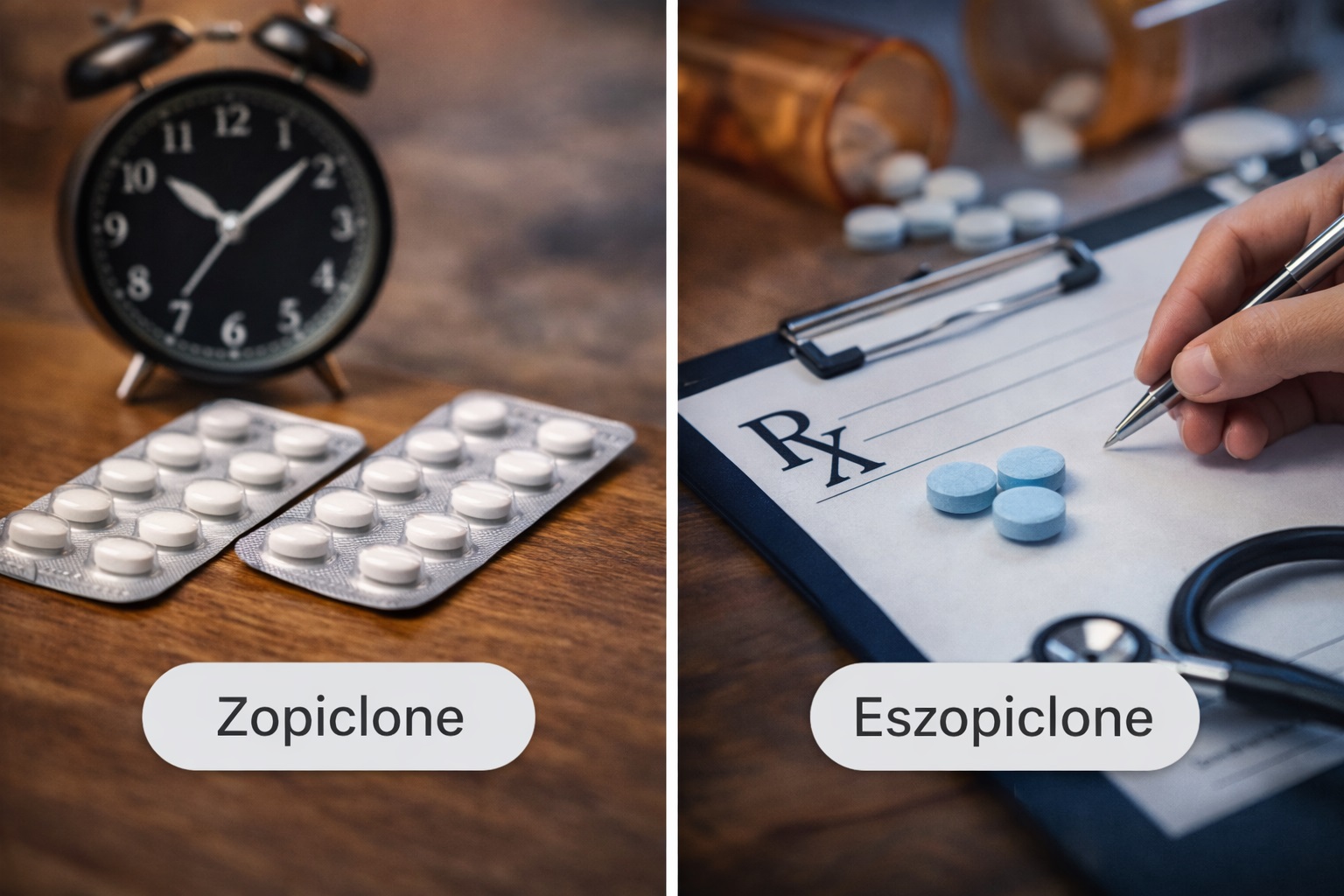
People researching prescription sleep medicines often come across two similar names—zopiclone and eszopiclone—and wonder whether they are basically the same drug. They’re closely related, but not identical in formulation, regulation, and how clinicians typically discuss dosing and next-day safety.
This article reflects Zopisign’s informational approach: clear, medically responsible, and non-promotional. For broader context on how we cover sleep medications, visit the main hub at Zopisign.
What is the relationship between zopiclone and eszopiclone?
The simplest way to explain it is that zopiclone is a mixture of two mirror-image forms (enantiomers), while eszopiclone contains only one of those forms.
]In more technical terms, eszopiclone is the S-enantiomer of racemic zopiclone, meaning it represents one “half” of the original mixed compound. This relationship is described in the official U.S. prescribing label for eszopiclone.
If you want a medication-specific overview focused on zopiclone itself, see zopiclone information.
How do they work in the body?
Both medicines are categorized as non-benzodiazepine hypnotics (often grouped informally as “Z-drugs”). Clinically, they are used to support sleep by acting on brain pathways associated with sedation.
In practical prescribing conversations, clinicians focus less on the chemistry and more on real-world outcomes:
- How quickly you fall asleep
- Whether you stay asleep
- How you feel the next morning
- Whether there are risks from other medications, alcohol, or medical conditions
Even when a medicine is effective for sleep initiation, it should not be viewed as a cure for the underlying cause of insomnia (stress, anxiety, pain, reflux, circadian timing, sleep apnea, etc.).
Indications and availability: why your country matters
One reason the two names cause confusion is that availability differs by region.
- Zopiclone is commonly prescribed in many countries outside the U.S.
- Eszopiclone is well known in the U.S. under the Lunesta brand name and generics, with labeling and dosing guidance defined by U.S. regulators.
Patients comparing products and regional naming may find it helpful to review zopiclone brands, especially if they are reading information across multiple countries’ sources.
Zopiclone vs Eszopiclone: Dosing differences patients commonly see
Dosing is individualized, and your clinician may adjust based on age, liver function, other medications, and sensitivity to sedation. Still, patients often notice that “typical tablet strengths” look different between the two drugs.
Eszopiclone tablets in the U.S. are commonly referenced in 1 mg, 2 mg, and 3 mg strengths in official labeling
Zopiclone, by contrast, is frequently discussed in strengths such as 3.75 mg and 7.5 mg in many prescribing environments (exact availability depends on country and manufacturer). If you’re comparing branded and generic positioning in patient-friendly language, see Zopisign vs zopiclone.
Important: This article is not a dosing instruction. A “common” strength is not automatically the “right” strength for you.
Next-day impairment: a key safety discussion for eszopiclone
For sleep medicines, one of the most important safety questions is: How alert are you the next day? Some people feel fine; others experience grogginess, slower reaction time, or impaired coordination.
The FDA specifically warned that eszopiclone can cause next-day impairment and lowered the recommended starting dose to reduce that risk: FDA Drug Safety Communication on next-day impairment with Lunesta (eszopiclone).
From a clinical perspective, this supports a broader principle used with hypnotics: use the lowest effective dose for the shortest necessary duration, and reassess promptly if morning impairment shows up—especially if you drive, operate machinery, or work in safety-sensitive roles.
Zopiclone vs Eszopiclone: Side Effects
Both medicines can cause similar side effects, but individuals vary widely. Commonly reported issues include:
- Unpleasant taste (often described as bitter or metallic)
- Dry mouth
- Dizziness
- Morning drowsiness (especially if sleep time is shortened)
- Reduced coordination
Less common but higher-risk concerns include confusion (particularly in older adults), falls, and unusual nighttime behaviors. Any severe or unusual effect should trigger a clinician check-in rather than “pushing through” it.
If you’re researching what’s included in various formulations and why tablet makeup can differ between manufacturers.
Duration of use and dependence risk
In real-world care, sleep medicines are often positioned as short-term support—for example during acute stress, travel disruption, grief, temporary medical flare-ups, or short-lived schedule instability.
In clinical practice, zopiclone is often prescribed when short-term sleep support is needed with a clear reassessment plan. The goal is usually to stabilize sleep while simultaneously addressing the drivers of insomnia and strengthening non-drug strategies.
If insomnia persists for weeks to months, clinicians typically re-check for:
- Anxiety or depression
- Sleep apnea or restless legs
- Circadian rhythm mismatch (late chronotype vs early obligations)
- Medication side effects
- Alcohol, cannabis, or sedative interactions
- Pain, reflux, or other medical contributors
Zopiclone vs eszopiclone: how clinicians often frame the choice
There is no universally “better” option. The decision is usually based on:
- Your symptom pattern (sleep onset vs sleep maintenance)
- Your risk of next-day impairment
- Age and fall risk
- Other medications (especially sedatives)
- Liver function and overall health
- Local availability and cost
Cost considerations can also influence what a patient actually receives in practice. For a patient-oriented discussion of pricing drivers, see Lunesta cost.
Practical takeaways for patients and caregivers
If you’re discussing these medicines with a clinician, consider asking:
- “Is my main issue falling asleep, staying asleep, or both?”
- “How long do you expect me to use this medication before reassessment?”
- “What would next-day impairment look like for me—and what should I do if it happens?”
- “Could another condition be causing my insomnia (sleep apnea, anxiety, reflux, pain, circadian timing)?”
And if you are already taking a hypnotic:
- Avoid alcohol and other sedatives unless your clinician explicitly advises otherwise.
- Protect a full sleep window when taking the medicine.
- Treat new confusion, falls, or unusual nighttime behaviors as a medical safety issue—not a minor inconvenience.